










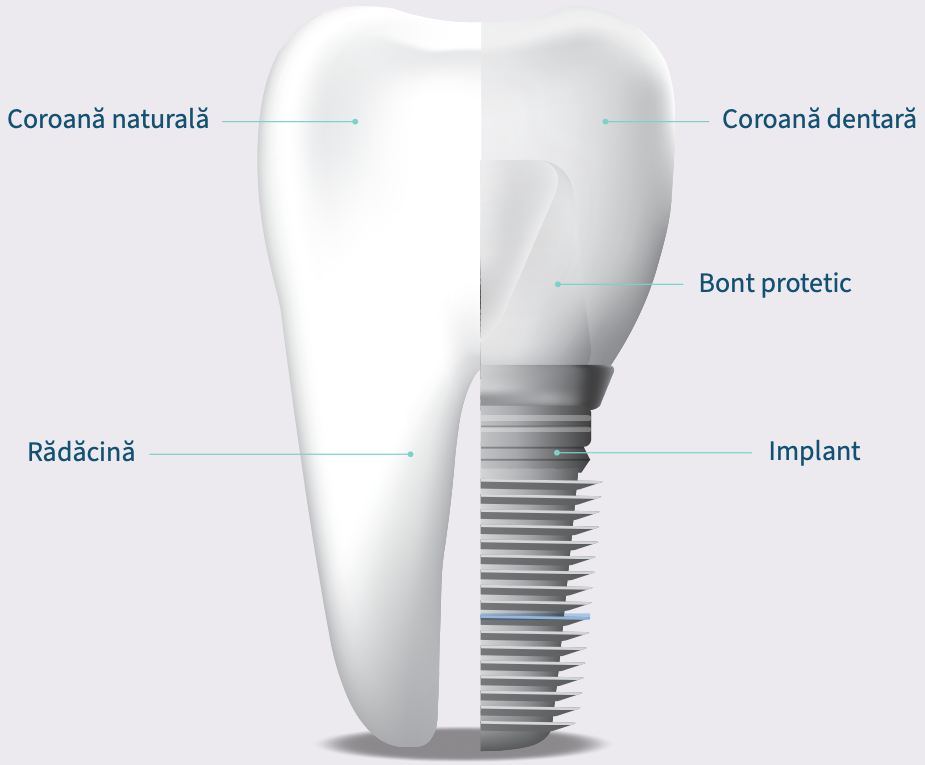
Implantology is the most effective method of replacing a missing tooth, offering functionality, natural aesthetics and longevity, similar to a natural tooth. The intervention is performed under local anesthesia, painlessly. The dental implant is a titanium screw, a material biocompatible with the human body, which replaces the root of the extracted tooth, being inserted into the mandible or jaw bone according to the illustration below.
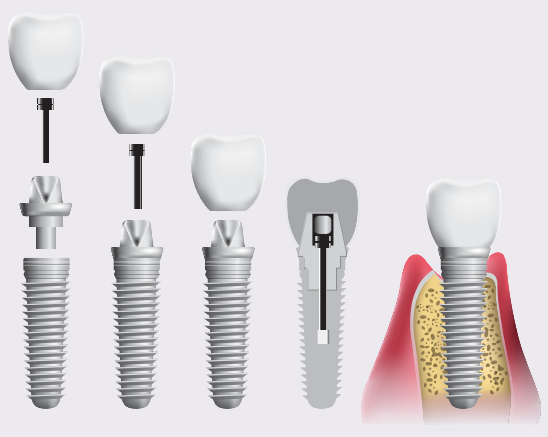
Treatment steps:
history, radiography, dental CT, osteodensitometry
a simple surgical procedure, under local anesthesia
called osseointegration
the aesthetic and functional part of the tooth
General conditions for implant insertion.
- The gums and the bone are healthy (no active infections).
- The patient has good oral hygiene.
- The general health is stable (no uncontrolled diabetes, no diseases that affect healing).
- Not recommended during pregnancy or in case of bisphosphonate treatments (for osteoporosis).
When is it recommended to insert a dental implant
1. After tooth loss (recent or old)
The implant is recommended whenever one or more teeth are missing — whether the extraction was done recently or the tooth has been missing for a longer time. The goal is to restore function (mastication, speech) and aesthetics.
2. Depending on the time after the extraction
There are 2 main timing options:
- Immediate implant (in the same session as the extraction)
- It is done on the same day the tooth is extracted.
- Advantage: shortens the treatment, preserves bone and gum volume.
- Disadvantage: cannot be applied in all cases (for example, in the presence of infection).
- Late implant (after 3–6 months or more)
- It is done after the bone has completely healed.
- It is the classic, safe option, but sometimes requires bone graft, because the bone can disolve over time after extraction.
3. After losing several teeth
Several implants can be placed for a small fixed dental work or for a total fixed work stabilized on implants (All-on-4 or All-on-6 type).
All-on-4 and All-on-6
Complete dental rehabilitation with All-on-4 and All-on-6 techniques
All-on-4 and All-on-6 techniques represent modern and effective solutions for complete restoration of the teeth, using a reduced number of dental implants. These procedures offer patients fixed, aesthetic and functional teeth, in a much shorter time compared to traditional methods.
All-on-4 involves the insertion of four dental implants in a single arch. Two implants are placed vertically in the front area, and the other two are inserted obliquely, in the back area, at an angle of approximately 45°. This technique is especially ideal for the lower arch and offers a safe solution even in cases of moderate bone resorption.
All-on-6 follows the same principle, but uses six dental implants, which ensures additional stability and optimal distribution of chewing powers. It is especially recommended for the upper arch, where the bone is usually less dense.
Both All-on-4 and All-on-6 allow for the immediate fixing of a temporary fixed prosthesis, so that the patient can leave the office with a complete smile as quickly as possible.
These techniques eliminate, in many cases, the need for additional interventions, such as bone grafts or sinus lifts, significantly reducing treatment and healing time.
Advantages of All-on-4 and All-on-6 treatments:
Who is the ideal candidate for All-on-4 / All-on-6 treatment?
The ideal candidate is the patient who wants fixed and stable teeth, without the discomfort of removable dentures. These techniques are suitable for:
- People who have lost all the teeth in an arch (upper or lower)
- Patients with mobile teeth, affected by periodontal disease
- Those who wear a removable prosthesis and want a fixed and comfortable solution
- People with moderate bone resorption, who want to avoid bone grafts
- Patients looking for a quick solution, with immediate and lasting results
General conditions:
- Good general health
- Proper oral hygiene and commitment to maintaining the results
- No serious uncontrolled systemic diseases (e.g. uncontrolled diabetes)
- Excessive smoking can affect the integration of implants, but is not an absolute contraindication
Find out if you are the right candidate!
Each patient has unique needs, and the treatment plan is established individually.
During an evaluation consultation, the implantologist will analyze the bone structure through a 3D tomography (CBCT) and recommend the optimal solution for you.
Schedule a consultation and find out if the All-on-4 or All-on-6 techniques are right for you!
Rediscover the pleasure of smiling, speaking and chewing without worries — with a fixed, beautiful and natural set of teeth!